Monday, May 18, 2015

Maintain Control of Your Forces at All Times

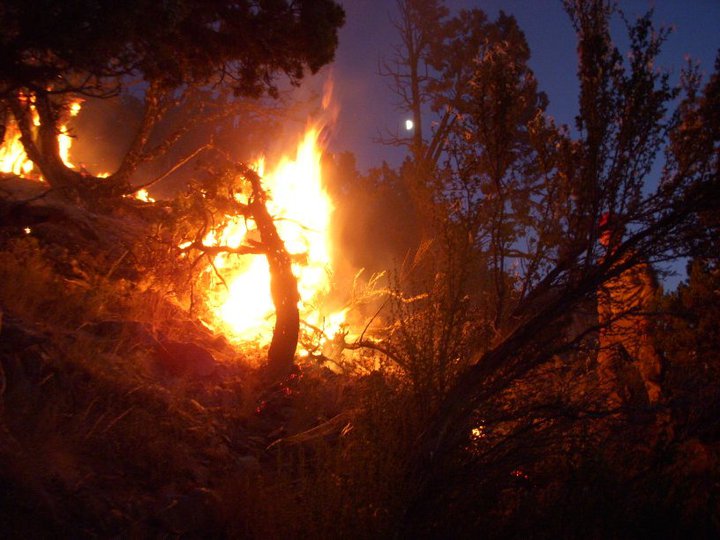
Fighting Fire is difficult and stressful. It means hiking farther than you think you can hike. It means being a team player even when you're exhausted and in desperate need of some alone time. It means facing the flames and the heat while breathing smoke. It is emotionally as well as physically taxing. Yet, we push through all the stress to get the job done. We keep the standard firefighting orders on our minds. One of these orders is, "maintain control of your forces at all times."

In fire this means to lead by example, to give clear instructions, and to maintain situational awareness. It means earning and keeping the respect of your subordinates, conducting maintenance on your tools and equipment, and taking care of your crew members. It also means controlling your thoughts, emotions, and actions. It means being alert, keeping calm, thinking clearly, and acting decisively. As a firefighter these things are in some ways easy. We have trained and practiced for those stressful situations. We work hard because we want to do a good job, because we want to maintain our safety, and because we care about our crew members.

In our personal lives it's not so easy to maintain control of our forces at all times. I know that I lose my temper or I let my emotions cloud my vision. I've experienced a lot of emotional stress over the course of my very young life. The years I spent in college were very emotionally difficult for me as I learned new things about the world and about myself. The past year, however, has been more emotional stress than I have ever experienced. It has been at times debilitating both physically and mentally. I feel ashamed as I think about the moments where I let my feelings of loss, sadness, aloneness, and uncertainty determine my thoughts and my actions. I did not maintain control of my mental forces. I did not maintain my alertness or calmness. I did not think clearly nor act decisively. Indeed, some moments I simply lay passive and let life drive over me.

As I think about it now, I have in my mind those people whom I hurt--including myself--by not treating my "home life" the same as my "work life." I did not consider the big picture, maintain my situational awareness, nor think about the safety of my "crew"--the people whom I love and who support me--before all else.

Now, as I gear up for another fire season sure to be filled with physically and mentally challenging situations, I'm also gearing up for those moments in my personal life where I will face emotional and mental challenges. Just like in my fire training, it will take practice, and as I start out, I imagine I will fumble a little bit before I become proficient; still, I'm confident that as I keep practicing, it will get smoother and easier.


Saturday, May 16, 2015

Gratitude

Today a man came up to me in the coffee shop and asked about my t-shirt from one of the big wildfires.  He wanted to know if I was an actual firefighter and when I told him I was he thanked me for what I do.  I don't normally think of myself as deserving of thanks. I am not the kind of firefighter that gears up, throws the oxygen tank on her back, and runs into burning buildings to save babies.

I am the kind of firefighter who throws her pack on, grabs a tool and hikes with her eyes focused on the feet in front of her. I am the kind of firefighter who digs and scrapes and drags brush and tree limbs. When the fire burns loud and hot, I hike out and wait. Most of the time I forget that even though I'm not working in burning buildings, the reason I hike into the mountains and dig line and spray down flames is to protect lives and property. Maybe I'm a little more disconnected from this truth, but people like the man in the coffee shop today remind me of my purpose, and I am grateful to know that my work is appreciated.

Monday, March 3, 2014

Destined to be a Hotshot

A woman and her pulaski in Arizona.
Last summer I had intended to write regular blogs about my adventures on a hotshot crew.
I, of course, failed at doing so and have neglected this blog since my first day as a hotshot.

There are so many different things that I need and want to write about, and I've decided that I will do so by way of a non-fiction book. It will detail what it's like to be a wildland firefighter--all the physical requirements, the fears, the struggles, the fatigue, the badass-ness--as well as involve histories of fire in the U.S., reactions to the tragedy at Yarnell Hill, and my opinions on what we can do to change the way we treat fire in the future.

I have wanted to be a hotshot wildland firefighter since I was seventeen years old when I first learned about the Snake River hotshots who were assigned to the same fire I was a camp crew member for near Zion National Park. I remember seeing their neon BLM-yellow crew buggies in the parking lot one morning before they left camp to work on the fire. I caught glances of the tough firefighters in their dirty clothes going about their morning routine as they prepared for the long day ahead of them. One of my camp crew leaders explained to me that hotshots are the most elite firefighters. They are experienced and strong, and the most respected. (I have of course since learned that smoke jumpers and heli-rappellers are stronger and more respected, but even they were all once hotshots themselves.) At that moment when I first saw them and the words Snake River Hotshots in big black letters across the top of their buggies, I decided that I would one day become a hotshot. It wasn't one of those crazy dreams of being an astronaut or an NBA player or the president of the United States sorts of things. I knew that one day it would happen--that one day that would be me climbing in the back of the crew carrier, fighting the the fires, and returning to camp covered in black soot looking exhausted and much like Dick Van Dyke in Mary Poppins.

Soon after that, I went through the training to become a Type 2 wildland firefighter and I worked on my first type 2 hand crew. Just being a firefighter was surreal and wonderful to me. As I progressed in the wildfire world into working on an engine crew and then in wildfire investigation, my goal of becoming a hotshot dwindled. I began to think that I wasn't cut out for that kind of work. I watched every now and then when the Bonneville Hotshots were at the BLM office in Salt Lake how they would do pull-ups in the back warehouse. All of them lined up and jumped up to the bar cranking out 10 pull-ups at a time, jumping down to get back in line, waiting to do it all over again. I didn't think I could do the kinds of work they did and so I became content with my half-field, half-office job of wildfire investigation.

At the end of the fire season, I applied for a dozen or more jobs, mostly hoping that I could work on an engine crew or a helitack crew, or most ideally, work as a wildfire investigator  closer to home (Ogden, Utah, where my lover and I lived at the time). I also applied for seasonal prescribed burning jobs in southeast U.S. for the winter, not wanting to be an un-employed ski bum like other fire seasonals I knew. Somehow in the mix of all these jobs I had mistakenly applied to a hotshot crew in Mississippi. I had an interview with the Assistant Superintendent, and a follow-up interview, and then I was offered a job. I didn't know what to do with myself it came as a surprise. But here was my chance to finally live out not just my dream, but what seemed to be my destiny of being a hotshot wildland firefighter.

I took the job and began my training.

Now, I'm preparing for my second season as a hotshot firefighter as I work with The Nature Conservancy on a prescribed burn crew.

I'm trying my damnedest to outline my non-fiction project, and perhaps put this blog to some use as I collect some thoughts and ideas.

Fire on!

Monday, May 20, 2013

Day 1 as a Hotshot Wildland Firefighter

For the first day on the hotshot crew we went through the physical requirement tests.
25 push-ups.
40 sit-ups.
7 pull-ups.
3 mile pack test with 45 lbs.

In some ways this year's pack test was the hardest one I've done. There were only old school weighted vests that had these huge pockets with lead plates in them. I tried to pick one of the smaller ones (I don't think any of them were smaller than any other), but I still ended up with a vest that looked like a dress on me. I waited until the very last second to put the vest on because 45lbs is a lot of weight when you're only 118 lbs yourself. Unfortunately, the buckles on my vest were all broken, so once we got started I had to hold the vest tight with my hands to keep it from flapping all over the place.

In other ways, I think this year I performed the best I ever had on the pack test (particularly when you consider how uncomfortable my vest was...). I finished at 41:17, and I only got one blister from the whole thing. I tend to get blisters every year from the pack test even though I haven't had blisters from anything else. Maybe it's just that speed walking makes my foot rub the wrong way in my shoe?

Overall, it was simple and easy. I finished my first day feeling strong, confident, and happy.

Fire Away!

Sunday, May 19, 2013

The Big Burn by Timothy Egan


Every wildland firefighter and every forester or Forest Service employee should be familiar with the history created by Teddy Roosevelt and Gifford Pinchot. Every wildland firefighter should know who Ed Pulaski is and what he did during the catastrophic fires of 1910.

The Big Burn is a great way to become acquainted with all of these people and with the history of the wildfire fighting program as well as the roots of forestry in the United States. The Big Burn is about Teddy Roosevelt, Gifford Pinchot, the origins of the Forest Service and land conservation, and, of course, the great fires of 1910 (and in that order).

 I have a really hard time getting invested in history books. I'm a little ashamed of that fact, but I'm also proud to say that I finished The Big Burn and I enjoyed it. For someone who expected to read about wildfires, I was disappointed at the intense history and biography portions at the beginning of the book. It was hard to get into, but once I'd trudged through several chapters, I actually appreciated knowing a lot of the histories and biographies.

Since this will be my 6th season in wildland firefighting, I'm a little embarrassed that it's taken me this long to become familiar with the history of fighting fire in the United States. I knew that the pulaski tool was named after the guy that made it, but I never knew just what kind of man Ed Pulaski was nor the courage and leadership he displayed as he fought wildfires in Montana.

I definitely recommend this book to anyone looking to know more about the beginnings of wild land firefighting. The seemingly boring beginning is worth trudging through.

Know of any other fire books or outdoor/survival books you think I should read?

Fire Away!

Friday, May 3, 2013

Fire Season by Philip Connors Book Review


I just finished reading Fire Season: Field Notes From a Wilderness Lookout. I've had this book for a couple seasons (a friend gave it to me for my birthday) and I finally got around to reading it.

I don't know why I waited so long, because the book was awesome. Phillip Connors does an excellent job at sharing bits of history in an interesting way while exploring the beauties of the seasonal solitary life of being a wilderness lookout.

One of the advance praise quotes on the back says, "I don't know what to call this soulful book. Memoir? Essay? History? And I don't know how it manages to turn months of solitude into such a gripping quest with vivid characters, including one of the Four Elements. What I do know is that Fire Season both evokes and honors the great hermit celebrants of nature, from Dillard to Kerouac to Thoreau--and I loved it." ---J.R. Moehringer

I have to agree with J.R. on this one. The book was very well done. I love non-fiction sort of self-exploration types of books. This book keeps an excellent pace and spends just the right amount of time on history and background of the setting and on Connors's personal adventures and reflections.

The only qualm I have with this book is the title...and that's only because I'm jealous that Connors took the title Fire Season before I could get to it and then used it for a wilderness lookout book that had not so much to do with wildfire as it did with hermitage. I had hoped there would be some big fire as the climax of the book, and was disappointed not to find it. Regardless, the book was well done, and it intrigued me enough to pique my interest in becoming a wilderness lookout one of these seasons.

If you like good writing and have any interest in the wilderness then I recommend this book.

Are there any awesome fire books that you think I should read?

Fire Away!


Tuesday, April 30, 2013

Z is for Zombie by the Cranberries

One of my favorite fire season songs  is Zombie by the Cranberries. It became a fire season song mostly because I happened to become obsessed with it during one of my first seasons, and it now reminds me of everything that comes with summer. Sitting around waiting for smoke reports, cleaning and greasing the leather boots, bouncing around on a dirt road toward the flame.


What's in your head?

Fire Away!

Saturday, April 27, 2013

W is for Watch Out Situations (18)

Along with the 10 Standard Firefighting Orders, there are 18 Watch Out Situations that every firefighter should have memorized.

1. Fire not scouted and sized up.
2. In country not seen in daylight.
3. Safety zones and escape routes not identified.
4. Unfamiliar with weather and local factors influencing fire behavior.
5. Uninformed on strategy, tactics, and hazards.
6. Instructions or assignments not clear.
7. No communication link with crew members/supervisors.
8. Constructing line without safe anchor point.
9. Building fireline downhill with fire below.
10. Attempting frontal assault on fire.
11. Unburned fuel between you and the fire.
12. Cannot see main fire, not in contact with anyone who can.
13. On a hillside where rolling material can ignite fuel below.
14. Weather is getting hotter and drier.
15. Wind increases and/or changes direction.
16. Getting frequent spot fires across line.
17. Terrain and fuels make escape to safety zones difficult.
18. Taking a nap near the fire line.

Tuesday, April 23, 2013

S is for Standard Firefighting Orders


There are 28 things that a firefighter ought to have memorized. I'll admit that I haven't put a whole lot of effort into memorizing these things during my past seasons. But as hotshot I feel it's absolutely critical to my safety to always have them in mind.

The first ten things are known as the Standard Firefighting Orders. And if you're into bible comparisons, these can easily be called the Ten Commandments of Firefighting.

1. Keep informed on fire weather and forecasts.
2. Know what your fire is doing at all times.
3. Base all actions on current and expected fire behavior.
4. Identify escape routes and safety zones and make them known.
5. Post lookouts when there is possible danger.
6. Be alert. Keep calm. Think clearly. Act decisively.
7. Maintain prompt communications with your forces, your supervisors, and your adjoining forces.
8. Give clear instructions and make sure they are understood.
9. Maintain control of your forces at all times.
10. Fight fire aggressively, having provided for safety first.


Fire Away!

Wednesday, April 17, 2013

N is for Night


I have never actually worked a night shift on fire in my 5
seasons. I imagine that one of these times I will, but from my limited experience in hiking off of a fire in the night I'm not exactly stoked on the idea. There are a few advantages to working the night shift on a wildfire. For one thing, it's a lot cooler at night, so working isn't quite so unbearable as the scorching sun added to the torching flames. Another thing is, it's easier to see spot fires and to know just where the heat is.
Since I've never done it before, I don't really know what other advantages or positives are.

There are a few downsides to working at night. Mostly, it has to do with visibility. Every firefighter carried a headlamp in their pack, but it doesn't make it a whole lot easier when you're  hiking on a steep, rocky slope (which can be difficult in broad daylight).

What do you think about working the night shift on a fire?
What are the positive aspects? Or the negative?

Fire Away!

Tuesday, April 16, 2013

M is for Muscles, Metabolism, and Meat


I've been working out consistently since the beginning of January. I have more defined muscles now than when I started, but I'm nowhere near having a muscular body. I kind of wish I had focused more on building muscle and gaining weight when I first started. The past couple weeks I've tried to gain weight (in the muscle department, ideally), and I don't feel like I'm really getting anywhere.

I know that a lot of people would love to have my metabolism, but right now I'm really cursing it. I feel like I'm constantly eating, and yet never reaching the calories I need in order to put on a few pounds. It's also very expensive to gain healthy weight, and I'm getting tired of going to the grocery so frequently.

When the guys on my crew found out I'm vegetarian, they seemed a little nervous for me...more nervous than they already were about my petiteness. As much as I like to think I can handle being vegetarian while performing all the same duties as any carnivore, it's just not that simple in the world of wildfire where I will rely on the contracted catering companies in fire camp to prepare my meals--that is, when I'm not eating MRE's (is anyone else thinking about that part in Tremors where Burt accidentally eats the toilet paper??).

Firefighters burn and therefore must consume anywhere between 4,000 and 10,000 calories a day. The way most caterers offer the amount of protein and calories we need is by slapping 6-10 slices of lunch meat between two slices of bread in addition to a granola bar, bag of smashed potato chips, apple or an orange, and some kind of fruit juice drink. Vegetarian lunches provided to firefighters can turn out to be just about anything. I've had mini pizzas (bread, sauce, and cheese) along with the usual snacks, which doesn't provide much protein at all. Often there are bean burritos or some gross kind of hummus in pita bread mixed with leftover veggies from the day before. Overall, fire lunches are pretty terrible (especially if you get the rainbow "beef" sandwich), but breakfast and dinner are no better.

As with most American diets breakfasts in fire camps revolve around eggs, bacon, and sausage, which all have high calories and protein and are also very non-vegetarian. Dinner always involves some form of chicken, pork, or steak, and all the gravies are made with meat (and most of the time even the beans or other "vegetarian" options are not really vegetarian).  So when you're trying to keep up with calories in camp, vegetarians have either got to succumb to being a seasonal carnivore or find some way (generally involving spending lots of personal cash on protein powders, etc) to supplement the vegetarian options supplied, or really suffer by way of weight loss and energy depletion.

Since this will be my first season on a hotshot crew, and because a couple guys on the crew recommended it, I've decided to succumb to being a seasonal carnivore and am therefor beginning now to get used to eating meat again. I've been warned that waiting until on a fire to jump into eating meat all day every day could easily make me sick--I have no doubts about that. So, today I decided to ease my way into the meat-eating by cooking up some free-range, vegetarian-fed chicken (drenched in BBQ sauce, of course). I have to admit, that underneath all the delicious BBQ sauce, chicken still tastes like paper. I don't know if I'll survive the summer on a carnivore diet...I'm already looking into what protein powders I can stock up on and stash in my PG bag.

Fire Away!

Monday, April 15, 2013

L is for LCES

In the fire world there are a lot of acronyms. It can be overwhelming at times, but I think in some ways it also helps to remember some of the important things when we're on the line.

LCES is the short version of the Standard Firefighting Orders (which I'll post about when I get to S).

LOOKOUTS
COMMUNICATION
ESCAPE ROUTES
SAFETY ZONES

For every fire operation, regardless of what crew you're on (even if you're the lowly camp crew) it's essential to establish each of these components before going about your duties. It's in the times that these things were overlooked that accidents and even disasters happen.

When I started out on the camp crews, no one ever told me about escape routes or safety zones if, for some reason the camp were to be overtaken with fire. It's easy to feel comfortable when you're nowhere near the fire (or so you think), but fire moves quickly and can be very unpredictable.

One of the fire camps I worked in with the camp crew happened to be situated in the middle of four different fires, which ended up burning together into one massive fire, and overtaking the whole fire camp. Luckily for me, my two weeks were over when that happened. However, there were still people in that camp--food crews, shower contractors, camp crews, and all the overhead/management people. From the stories I heard, it was chaos in that camp. Most of the people (if any at all) were not aware of what safety zones or escape routes even were let alone where they were and when to use them. This is an example of poor communication. Also, it seems like they would have gotten people out of harms way a lot easier if there had been lookouts properly posted to give updates on the fire activity and location.


It's easy to identify what the problems were when things have gone wrong, but the more difficult task is remembering to cover all the bases as you're working. It's identifying what you need in the moment that really makes the difference.

Some things may seem to get repetitive after hearing them over and over in briefings and after action reviews, but when your life and the lives of your crew members are on the line then it's good to get past the redundancy and really make sure that LCES are in place.

Do you have any examples of situations gone wrong (or right) because of LCES?

Fire Away!


Friday, April 12, 2013

H is for Helicopters

Helicopters are great assets when it comes to fighting fire. They carry out bucket drops, transport crews into gnarly territory, and act as eagle eyes for those on the ground.


My first helicopter ride lasted about two minutes. The guys on my crew let me sit in the front seat next to the pilot which gave me an awesome view of the Great Salt Lake reflecting the pinks and orange of the western sky. With only an hour or two of daylight left, the helicopter crew helped transport us and all our gear to the top of the mountain so we could attack the fire and hike back down. (Unfortunately, there was a big flare-up which kept us on the mountain until after dark and we hiked down with our headlamps.)

The second helicopter ride was a few minutes longer, and pretty damn exciting (though nothing to compete with skydiving). I was transported with a crew to the top of a mountain again, but because of how far away everything was, we got to have a ride back to camp instead of hiking down in the dark.

Helicopters are kinda scary...but mostly I think they're really cool.

Fire Away!

Tuesday, April 9, 2013

G is for Goals

keep your eye on the goal

As a wildland firefighter I've had to fill out forms and charts with my career goals.

There are boxes for the "end goal" I want on a short term basis (6 mo - 1 yr) such as open a taskbook for PIO, or become a qualified Wildland Fire Investigator.

Then there are other boxes for how to get to those goals, which might be include things like, volunteer to help with Public Information Officer tasks, take the required training courses, or talk to the AFMO to get a taskbook initiated. Or it might include things like take the lead on more investigations, attend annual refresher trainings, or assist with the weeklong investigation training course.

Then there's a whole other section for long term goals (1 - 6 yrs or something) in which I put: Get a permanent (or career seasonal) job as a wildland firefighter or fire investigator. And this has a lot of steps. Because, first I need more fire experience and I need to be willing to move around to find an opening. I'll need more training, and more leadership experiences.

One of my goals (which I originally put on the short-term basis) has simply been to move to a higher pay level. Right now I'm a GS-4. Generally, in order to move to a higher pay level (other than finding someone who is willing to promote you) you've got to have at least one year or season working in the level just before it. But in order to become a GS-5 in wildland firefighting, you have to also have the FFT1/ICT5 (Firefighter Type 1/Incident Commander Type 5) qualifications on your redcard.

I've been a GS-4 for two fire seasons plus about 9 months on the off season. This summer will be my third summer as a GS-4, because even though I opened my taskbook for the FFT1/ICT5 quals in 2010, I didn't had much of a chance to work on them while my primary role was fire investigations.  

I was eager to get signed off as a lead firefighter, thinking that I understand the basic concepts and I know the protocols, but when I had a chance to roll with a hand crew as a FFT1 trainee, I realized that I simply don't have the fire experience I need to really know the game in a leadership role.

I'm still anxious to get signed off and to be able to move up in pay level, but I'm realizing that even after this season is finished, I might not have those quals for next season. It really sucks when I think about it in terms of money, but when I look at it from a fire perspective I think it's okay. I wouldn't want to be signed off for a role that I may not know how to fill properly--something that I generally think is different in fields other than firefighting where proper experience and know how can be life or death.

One of the reasons I really wanted this job as a hotshot was so I could get a lot of fire experience. And I know I will. I'll be working 16 hour days for several weeks at a time with little sleep, bad food, and probably no showers. My hope is that when I come out of this season, I will feel more comfortable in the role of wildland firefighter to the point that I can step confidently into a leadership position.

So, for now, my short term goals for this fire season are:
1. Make friends with everyone on my crew
2. Stay strong
3. See a lot of fire
4. Feel more confident as a wildland firefighter

And next season, wherever the wind chooses to blow me, my goal is to get qualified as FFT1, so that one of these days I can move up in pay status.

Do you have any goals for this summer? Or the next?

Fire Away!

Monday, April 8, 2013

F is for Frosty

In my attempts to gain weight (mostly in the muscle category) I've been making my own versions of the Wendy's Frosty. Of course it's not anything like a Wendy's Frosty...because it's actually good for you, but I think it tastes pretty good.

Here's what I put in it:

1 scoop Raw SunWarrior Protein Powder (Vanilla flavor) 16g protein
1/2 scoop Raw Cacao powder 5g protein
handful of raw almonds 5-6g protein
1/2 cup almond milk (Vanilla flavor)  .75g protein
6-10 cubes of ice

Blend it all up until it's the consistency of a frosty and enjoy :)


Sometimes I like to add two cups of spinach, which doesn't really affect the taste, but it seems somehow to make the texture a little less frosty-like.

Do you have any awesome protein shakes or recipes?

Fire Away!

Saturday, April 6, 2013

E is for Engine

Type 4 BLM Engine

Working on an engine was one of my favorite fire seasons. I loved driving a monster truck built to protect and preserve rather than destroy.

I loved the hard work of hauling hose and humping around a 30lb bladder bag.

I even learned to enjoy the daily preventative maintenance, as mundane as it seemed sometimes.

There are so many facets in wildfire, and even though I'm doing a taste test of as many as I can, I have to say that there's something really great about working on an engine.

Some people like to say that engine life is a luxury. There are a lot of nice things about working on an engine that you don't get with hand crews. One of those is that you often get to sleep in a bed at night. Engines roll primarily as initial attack, which means they are the first resources called to a scene.  A lot of the time and engine or two can get a fire contained and controlled quickly.

Engine work is nice because you work with a small crew, which means it's easier to have a routine and established ways of doing things.

Some people like to say that engines are for lazy firefighters, and while that might be the case with some engines, I don't think it's true for most. At least it wasn't true for my crew. We had intense physical training every day that often included quick-paced, steep hikes, P90X workouts, and lots of pull-ups.
Rolling Attack

There were a few times when we would use "rolling attack"on fires (a technique where one person drives the engine around the edge of a fire while another walks with a hose, spraying down the fire), but because the majority of fires in our district were on the steep slopes of mountains, my engine crew did a lot more hiking and carrying bladder bags than anything else.


Engine work, like most firefighting work was exhausting. And I often arrived back at the station looking like this:


Sometimes, I looked like this: 


And riding in the engine through Utah's West Desert pretty much always looked a lot like this: 


Do you have a favorite wildland fire crew? 
Any comments or questions about being on an engine? 

Fire Away!

Friday, April 5, 2013

D is for Death and Dancing

Yesterday my friend Sarah wrote a post about Death.  It was one of the first things I saw in the morning as I flipped through my emails. I didn't expect it to be such an omen as it turned out to be.

I didn't write my D post yesterday. So, today it will stand for Delay.
Because yesterday it was for Death and Dancing.

My grandma died yesterday.


It sure brings Sarah's post a little closer to home than it did originally. And I can't help but agree with her that "...part of the human experience is wrestling with the concept of Death." 

I've never really understood the sadness that seems to come with death until now. 
I miss my grandma. 
She was always a big part of my life as I grew up. Since she lived right next door, I saw her pretty much everyday as a child. She always had little cakes and cookies. And at church she always carried mints and lemon cough drops which I ate like candy. 

Her favorite food was ice cream. Her least favorite was steak. She never ate meat that I knew of, not even in hamburger helper, and for the longest time I thought that was so weird. Now, it makes a lot of sense to me. She loved diet root beer, and would often mix it with orange juice which I thought was really gross until I tried it. 

For the most part she was a calm, gentle, and mostly quiet woman. But she had a boisterous laugh, and if she was ever upset or feeding the cats her voice could be heard throughout the entire neighborhood. 


My Movie Star Grandma
She loved cats, and always kept a bucket of cat food behind the door, so she could feed pretty much every cat that would come to her calling (every cat in the neighborhood). 

Grandma loved to dance. 
She was never an incredible dancer or anything. Her dancing seemed more like a waddling sway, but she loved to dance and laugh and smile and sing. 


I know that death is one of those mysteries that we never understand during life. No one can ever tell us what it's like, but I've wondered what it would be like to watch someone die. How must that feel? Do the energies in the room change as spirits shift out of the body? What's the difference between life there in the body and when the life has gone? 

Death is often the subject of mystery novels, but no matter how skilled you are as a detective, always the one mystery remains after cause of death has been determined: Where does the life go? 

I could speculate as many do, but I'm content knowing that my grandma lived a good life and that wherever her soul or her life-energy has moved to, her love will always resonate throughout time and space. 

Here's to the mysteries of existence, the power of one person's love, and the joy of dancing through life. 

Fire Away!

Wednesday, April 3, 2013

Charlie as in Calorie Counting

When I met the assistant superintendent for the Jackson hotshots he said what I think most of my phone interviewers have thought,"I thought you'd be bigger." This coming after I had disclosed my height and weight a couple times already in phone conversations. The truth is, I'm a very small person in terms of my physical body. I am five feet and four inches tall. I currently weigh 110 pounds, which is about ten pounds lighter than I normally am and would like to be. I think in all of my training the past two or three months I've not kept up with the calories I need to maintain my preferred body weight. Because I'm tired of people looking at me and thinking I couldn't possibly be a fire fighter, and because I want to look a little more lean I've decided it's time to start counting calories. I've never paid attention to calories before--mostly because it seemed that only people who wanted to lose weight watched their calories. Rather than trying to cut calories and avoid fat, my goal is to increase my caloric intake to exceed those spent during regular metabolic processes as well as those spent in my workouts which are only getting harder as I move further along in my half marathon training. To anyone trying to lose weight, I know that it's hard; but look at the bright side: at least it's cheaper to lose weight than it is to gain it. :-) Eating more calories has meant more trips to the store which means more money it of my bank account, not to mention all the extra time I spend on cooking, eating, and doing the dishes. Sometimes I wish I were in need of losing a few pounds just so I could be saving a few extra pennies. Another challenge I'm faced with that weight losers have going for them is appetite. When you exercise you trend to have a smaller appetite. I'm trying to get onto a regular schedule to make eating easier, because going off of my appetite doesn't keep up with my needed calories when I'm exercising six days a week. I never thought I'd say it but, I'm now officially a weight watcher. My heart goes out to all the weight watchers and calorie counters out there, whichever way you're trying to top the scale! Fire away!

Tuesday, April 2, 2013

B is for Boots

Before I could do anything in the field as a wildland firefighter I had to have the right footwear.


I love shoes. Don't take this the wrong way... I'm not exactly a stereotypical girl who loves to go shoe shopping and owns several different pairs of high heels and whatnot. I love how shoes are so versatile. Maybe hats are the usual metaphor for being versatile and having many trades, but shoes seem to be the more literal indication of just how many different personas I wear. 

I have the more practical shoes such as my chacos, snow boots (maybe not so practical for Mississippi), and rock climbing shoes (also maybe not so practical for MS...). I have my dressy shoes--yes, I do own heels. I have my "Bride's Maid shoes" which are a pair of sparkly sandals that I've worn as a bride's maid a few times. I've got my comfort shoes: brown slippers which I fondly call "slippies" and my worn out Vans that also, of course, slip on. 

Shoes are important for a lot of things, but I've never had a more important pair of shoes than my fire boots. Never has a pair of shoes protected me from some of the most dangerous aspects of nature (except maybe my snow boots). There's almost nothing more important on the fireline than your feet. If you've got blisters then you can't work. If you can't work, then you don't get paid and you don't have any fun.

The standard for fire boots is that they must be all leather (no nails in the bottom; it must be sewn on, and no steel toe). They must also be at least 8 inches from heel to calf. Some people go so far as to have boots that lace all the way up to the knee--especially good for sawyers, I've heard.

Later I'll try to post more about breaking in your boots the right way, how to take care of them, and how to not get blisters, so stay tuned and stay safe!

Fire Away!

Monday, April 1, 2013

A is for Alpha and Whiskey Tango Foxtrot

This month I'm taking on the blogger A to Z challenge. What's better than starting off with the alphabet itself?

The military uses what's known as the NATO phonetic alphabet. The more accurate name for this is International Radiotelephony Spelling Alphabet. "Phonetic" is technically the wrong term because it refers to the actual sounds that a single letter makes. The NATO alphabet on the other hand is used to solve the common problem of spelling out words during radio communication. Sometimes B sounds like too much like D, so there's a specific word for each letter. B as in Bravo. D as in Delta. In firefighting we use this alphabet a lot. Whether it's communicating on the radio about what resources have arrived on scene (maybe it's a helicopter with the call sign 2BH, then over the radio we'd say Two Bravo Hotel) or simply spelling out words or names that are easily mixed up with something else (Boyle vs Doyle) this alphabet makes communication a lot easier.

 Here's the complete Spelling Alphabet (with phonetic pronunciation): 
A-Alpha (AL-FAH)
B-Bravo (BRAH-VOH)
C-Charlie (CHAR-LEE)
D-Delta (DEL-TAH)
E-Echo (ECK-OH)
F-Foxtrot (FOKS-TROT)
G-Golf (GOLF)
H-Hotel (HOH-TEL)
I-India (IN-DEE-AH)
J-Juliet (JEW-LEE-ETT)
K-Kilo (KEY-LOH)
L-Lima (LEE-MAH)
M-Mike (MIKE)
N-November (NO-VEM-BER)
O-Oscar (OSS-CAH--although if I said it would sound more like OSS-KER)
P-Papa (PAH-PAH)
Q-Quebec (KEH-BECK)
R-Romeo (ROW-MEE-OH)
S-Sierra (SEE-AIR-RAH)
T-Tango (TANG-GO)
U-Uniform (YOU-NEE-FORM)
V-Victor (VICK-TAH--or VICK-TOR)
W-Whiskey (WISS-KEY)
X-XRay (EKS-RAY)
Y-Yankee (YANG-KEE)
Z-Zulu (ZOO-LOO)

My favorite letters to use are Whiskey Tango Foxtrot (WTF). And I especially like to pretend I'm on the radio--"Whiskey Tango Foxtrot; Over."

Do you use this international spelling alphabet in your job? Why? Is it effective?
What's your favorite acronym?

Comments or suggestions on the Wild Fire Lady blog?

Fire Away!