For the first day on the hotshot crew we went through the physical requirement tests.
25 push-ups.
40 sit-ups.
7 pull-ups.
3 mile pack test with 45 lbs.
In some ways this year's pack test was the hardest one I've done. There were only old school weighted vests that had these huge pockets with lead plates in them. I tried to pick one of the smaller ones (I don't think any of them were smaller than any other), but I still ended up with a vest that looked like a dress on me. I waited until the very last second to put the vest on because 45lbs is a lot of weight when you're only 118 lbs yourself. Unfortunately, the buckles on my vest were all broken, so once we got started I had to hold the vest tight with my hands to keep it from flapping all over the place.
In other ways, I think this year I performed the best I ever had on the pack test (particularly when you consider how uncomfortable my vest was...). I finished at 41:17, and I only got one blister from the whole thing. I tend to get blisters every year from the pack test even though I haven't had blisters from anything else. Maybe it's just that speed walking makes my foot rub the wrong way in my shoe?
Overall, it was simple and easy. I finished my first day feeling strong, confident, and happy.
Fire Away!
Monday, May 20, 2013

Sunday, May 19, 2013
The Big Burn by Timothy Egan

Every wildland firefighter and every forester or Forest Service employee should be familiar with the history created by Teddy Roosevelt and Gifford Pinchot. Every wildland firefighter should know who Ed Pulaski is and what he did during the catastrophic fires of 1910.
The Big Burn is a great way to become acquainted with all of these people and with the history of the wildfire fighting program as well as the roots of forestry in the United States. The Big Burn is about Teddy Roosevelt, Gifford Pinchot, the origins of the Forest Service and land conservation, and, of course, the great fires of 1910 (and in that order).
Since this will be my 6th season in wildland firefighting, I'm a little embarrassed that it's taken me this long to become familiar with the history of fighting fire in the United States. I knew that the pulaski tool was named after the guy that made it, but I never knew just what kind of man Ed Pulaski was nor the courage and leadership he displayed as he fought wildfires in Montana.
I definitely recommend this book to anyone looking to know more about the beginnings of wild land firefighting. The seemingly boring beginning is worth trudging through.
Know of any other fire books or outdoor/survival books you think I should read?
Fire Away!
Friday, May 3, 2013
Fire Season by Philip Connors Book Review

I just finished reading Fire Season: Field Notes From a Wilderness Lookout. I've had this book for a couple seasons (a friend gave it to me for my birthday) and I finally got around to reading it.
I don't know why I waited so long, because the book was awesome. Phillip Connors does an excellent job at sharing bits of history in an interesting way while exploring the beauties of the seasonal solitary life of being a wilderness lookout.
One of the advance praise quotes on the back says, "I don't know what to call this soulful book. Memoir? Essay? History? And I don't know how it manages to turn months of solitude into such a gripping quest with vivid characters, including one of the Four Elements. What I do know is that Fire Season both evokes and honors the great hermit celebrants of nature, from Dillard to Kerouac to Thoreau--and I loved it." ---J.R. Moehringer
I have to agree with J.R. on this one. The book was very well done. I love non-fiction sort of self-exploration types of books. This book keeps an excellent pace and spends just the right amount of time on history and background of the setting and on Connors's personal adventures and reflections.
The only qualm I have with this book is the title...and that's only because I'm jealous that Connors took the title Fire Season before I could get to it and then used it for a wilderness lookout book that had not so much to do with wildfire as it did with hermitage. I had hoped there would be some big fire as the climax of the book, and was disappointed not to find it. Regardless, the book was well done, and it intrigued me enough to pique my interest in becoming a wilderness lookout one of these seasons.
If you like good writing and have any interest in the wilderness then I recommend this book.
Are there any awesome fire books that you think I should read?
Fire Away!
Tuesday, April 30, 2013
Z is for Zombie by the Cranberries
One of my favorite fire season songs is Zombie by the Cranberries. It became a fire season song mostly because I happened to become obsessed with it during one of my first seasons, and it now reminds me of everything that comes with summer. Sitting around waiting for smoke reports, cleaning and greasing the leather boots, bouncing around on a dirt road toward the flame.
What's in your head?
Fire Away!
What's in your head?
Fire Away!
Saturday, April 27, 2013
W is for Watch Out Situations (18)
Along with the 10 Standard Firefighting Orders, there are 18 Watch Out Situations that every firefighter should have memorized.
1. Fire not scouted and sized up.
2. In country not seen in daylight.
3. Safety zones and escape routes not identified.
4. Unfamiliar with weather and local factors influencing fire behavior.
5. Uninformed on strategy, tactics, and hazards.
6. Instructions or assignments not clear.
7. No communication link with crew members/supervisors.
8. Constructing line without safe anchor point.
9. Building fireline downhill with fire below.
10. Attempting frontal assault on fire.
11. Unburned fuel between you and the fire.
12. Cannot see main fire, not in contact with anyone who can.
13. On a hillside where rolling material can ignite fuel below.
14. Weather is getting hotter and drier.
15. Wind increases and/or changes direction.
16. Getting frequent spot fires across line.
17. Terrain and fuels make escape to safety zones difficult.
18. Taking a nap near the fire line.
1. Fire not scouted and sized up.
2. In country not seen in daylight.
3. Safety zones and escape routes not identified.
4. Unfamiliar with weather and local factors influencing fire behavior.
5. Uninformed on strategy, tactics, and hazards.
6. Instructions or assignments not clear.
7. No communication link with crew members/supervisors.
8. Constructing line without safe anchor point.
9. Building fireline downhill with fire below.
10. Attempting frontal assault on fire.
11. Unburned fuel between you and the fire.
12. Cannot see main fire, not in contact with anyone who can.
13. On a hillside where rolling material can ignite fuel below.
14. Weather is getting hotter and drier.
15. Wind increases and/or changes direction.
16. Getting frequent spot fires across line.
17. Terrain and fuels make escape to safety zones difficult.
18. Taking a nap near the fire line.
Tuesday, April 23, 2013
S is for Standard Firefighting Orders

The first ten things are known as the Standard Firefighting Orders. And if you're into bible comparisons, these can easily be called the Ten Commandments of Firefighting.
1. Keep informed on fire weather and forecasts.
2. Know what your fire is doing at all times.
3. Base all actions on current and expected fire behavior.
4. Identify escape routes and safety zones and make them known.
5. Post lookouts when there is possible danger.
6. Be alert. Keep calm. Think clearly. Act decisively.
7. Maintain prompt communications with your forces, your supervisors, and your adjoining forces.
8. Give clear instructions and make sure they are understood.
9. Maintain control of your forces at all times.
10. Fight fire aggressively, having provided for safety first.
Fire Away!
Wednesday, April 17, 2013
N is for Night
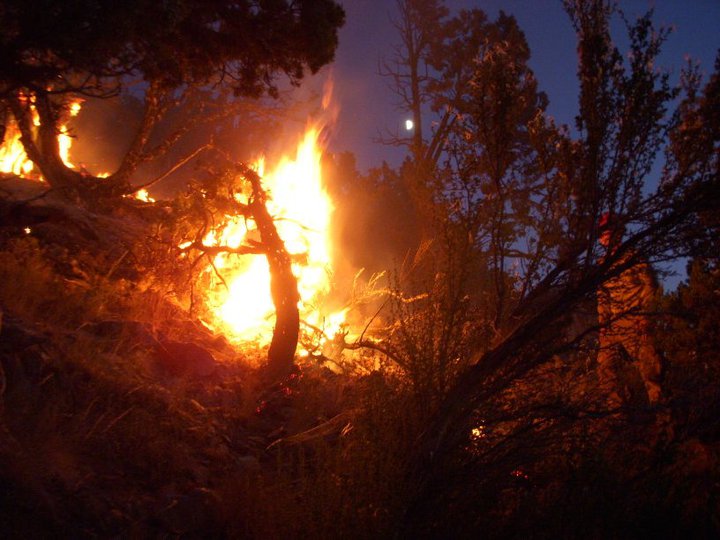
 I have never actually worked a night shift on fire in my 5
seasons. I imagine that one of these times I will, but from my limited experience in hiking off of a fire in the night I'm not exactly stoked on the idea. There are a few advantages to working the night shift on a wildfire. For one thing, it's a lot cooler at night, so working isn't quite so unbearable as the scorching sun added to the torching flames. Another thing is, it's easier to see spot fires and to know just where the heat is.
Since I've never done it before, I don't really know what other advantages or positives are.
There are a few downsides to working at night. Mostly, it has to do with visibility. Every firefighter carried a headlamp in their pack, but it doesn't make it a whole lot easier when you're hiking on a steep, rocky slope (which can be difficult in broad daylight).
What do you think about working the night shift on a fire?
What are the positive aspects? Or the negative?
Fire Away!
Subscribe to:
Posts (Atom)